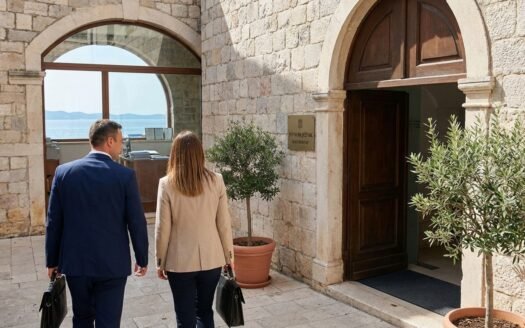
Navigating the Property Closing Process in Croatia
You have found your dream property in Croatia, negotiated the price, and completed your due diligence. Now comes the final stage: closing the deal. The Croatian property closing process has specific steps and requirements that differ from many other countries.
Here is what to expect from pre-contract to keys in hand.
The Pre-Contract (Predugovor)
The closing process in Croatia typically begins with a pre-contract. This legally binding agreement outlines the agreed purchase price, payment terms and timeline, conditions that must be met before the final contract (such as Ministry of Justice approval for non-EU buyers), deposit amount (typically 10%), and consequences for either party withdrawing.
The pre-contract is usually prepared by the buyer’s lawyer and signed by both parties. The deposit is paid at this stage, typically to the seller’s account or into an escrow arrangement.
Fulfilling Conditions
Between the pre-contract and final contract, several conditions may need to be met. Your lawyer will finalize due diligence and confirm clear title, non-EU buyers will await Ministry of Justice approval (typically 2-6 months), mortgage approval will be confirmed if applicable, and any agreed repairs or conditions from the seller will be completed.
The Final Purchase Agreement (Kupoprodajni Ugovor)
Once all conditions are satisfied, the final purchase agreement is prepared. This comprehensive contract includes the full legal description of the property, final purchase price, payment instructions, date of possession and key handover, representations and warranties from both parties, and a clause allowing the buyer to register ownership in the land registry (clausula intabulandi).
This clause is critical — without it, you cannot register as the legal owner.
Notarization
The final contract must be signed before a Croatian notary (javni bilježnik). The notary verifies the identities of both parties, confirms both parties understand the contract terms, certifies the signatures, and ensures the contract meets legal requirements.
If you cannot be present in person, you can authorize a representative through a power of attorney, which itself must be notarized and apostilled.
Payment
The remaining purchase price (after deducting the deposit) is paid according to the contract terms. Payment is typically made via bank transfer to the seller’s Croatian bank account. Keep all payment receipts — you will need them for tax purposes.
Tax Payment
Within 30 days of signing the final contract, the buyer must report the transaction to the Tax Administration. The notary typically submits this notification automatically. The Tax Administration will then issue an assessment for the 3% real estate transfer tax (or confirm VAT exemption for new builds). Payment is due within 15 days of receiving the assessment.
Land Registry Registration
The final and most important step is registering your ownership in the land registry (gruntovnica). Your lawyer submits the registration application along with the notarized contract and proof of tax payment. Once registered, you are the legal owner with full property rights. This process typically takes a few weeks to a few months, depending on the court’s workload.
Key Handover and Utilities
On the agreed possession date, the seller hands over the keys and all relevant documentation, including utility account details, building management contacts, and any warranties or manuals. Utility accounts (electricity, water, gas, internet) need to be transferred to your name — your agent can assist with this process.
We Handle the Details
At 385 Real Estate, we coordinate the entire closing process for our clients, working closely with your lawyer, the notary, and the seller’s representatives to ensure everything runs smoothly. Contact us at info@385realestate.hr or +385 99 385 7325.