
Ownership Rights in Croatia – What Foreign Buyers Need
Most Canadian buyers are surprised to learn that property ownership laws in Croatia offer robust constitutional protections for foreign investors, yet impose unique rules depending on nationality and property type. For North American and Australian expatriates seeking a Croatian home or holiday retreat, understanding these legal distinctions is vital for a smooth transaction and lasting peace of mind. This guide brings practical clarity to ownership rights, legal frameworks, and critical steps you need to secure property confidently in Croatia.
Table of Contents
- Defining Ownership Rights In Croatia
- Property Types And Ownership Structures
- Legal Framework For Foreign Property Buyers
- Acquisition Process And Due Diligence Steps
- Obligations, Risks, And Tax Considerations
Key Takeaways
| Point | Details |
|---|---|
| Understanding Ownership Rights | Property ownership rights in Croatia are rooted in constitutional guarantees, with variations based on property type and region. Foreign buyers should engage local legal experts to navigate restrictions effectively. |
| Foreign Buyer Regulations | Different regulations apply to EU citizens, OECD nationals, and non-EU citizens, impacting property acquisition complexity. Non-EU buyers must often demonstrate reciprocal rights from their home countries. |
| Due Diligence is Crucial | A thorough due diligence process, including a title search and compliance with documentation requirements, is essential for successful property transactions in Croatia. Legal and administrative hurdles can complicate ownership transfers. |
| Tax and Legal Responsibilities | Property ownership entails various tax obligations and legal liabilities, including property transfer taxes and income taxes from rentals. Investors should consult local advisors to mitigate risks and ensure compliance. |
Defining Ownership Rights in Croatia
Understanding property ownership rights in Croatia requires navigating a nuanced legal landscape that balances constitutional guarantees with strategic regulatory frameworks. Property ownership regulations in Croatia are grounded in constitutional principles that protect both domestic and international investors, ensuring transparent and equitable real estate transactions.
The Croatian legal system provides robust protections for property owners through its comprehensive Civil Code, which defines ownership as a fundamental right. Foreign investors can acquire property rights under specific conditions, with regulations designed to integrate seamlessly with European Union standards. The constitutional framework under Article 48 explicitly guarantees property rights, creating a stable environment for international real estate investments.
Foreign buyers must understand that ownership rights in Croatia are not uniform across all property types and regions. Some areas have additional restrictions, particularly for agricultural lands and properties in strategic locations. Recent amendments to ownership regulations have simplified acquisition processes for international investors, removing previous ministerial consent requirements and creating more transparent pathways to property ownership.
Pro tip: Before finalizing any property purchase in Croatia, always engage a local legal professional specializing in real estate to review specific ownership restrictions and verify complete compliance with current regulations.
Property Types and Ownership Structures
Croatia’s property ownership landscape encompasses diverse structures that reflect complex legal frameworks designed to protect both local and international investors. Property ownership categories range from individual private ownership to more intricate arrangements involving co-ownership, leaseholds, and proprietary rights that provide nuanced legal protections for different types of real estate assets.

The legal system distinguishes between several fundamental ownership structures, including individual ownership, joint ownership, and corporate ownership. Individual ownership represents the most straightforward property right, where a single entity holds complete legal title. Joint ownership allows multiple parties to share property rights, with specific legal mechanisms governing how shared properties can be managed, transferred, or divided. Corporate ownership enables business entities to acquire and manage real estate assets under structured legal frameworks that provide additional layers of protection and operational flexibility.
Property rights regulations also differentiate between movable and immovable property, each with unique legal implications. Immovable property, such as land and buildings, involves more complex registration requirements and potential restrictions, particularly for agricultural lands and properties in strategically sensitive regions. These nuanced regulations ensure that property transfers and ownership transitions maintain national economic interests while providing clear pathways for legitimate international investments.
Pro tip: Consult a Croatian real estate lawyer specializing in property law to conduct a comprehensive title search and understand the specific ownership restrictions associated with the particular property type and location you are interested in acquiring.
The types of property ownership in Croatia differ in terms of structure and legal implications. Here is a summary:
| Ownership Structure | Description | Key Legal Considerations |
|---|---|---|
| Individual Ownership | One person holds full title | Simplest form, direct management |
| Joint Ownership | Multiple owners share title | Sharing rights, transfer rules |
| Corporate Ownership | Company or legal entity holds property | Enhanced protection, flexibility |
| Leasehold | Right to use property for a set period | Renewal, termination, obligations |
Legal Framework for Foreign Property Buyers
Navigating the legal landscape for foreign property acquisition in Croatia requires understanding a complex set of regulations that vary depending on the buyer’s national origin. Legal requirements for foreign nationals establish different pathways for property ownership based on international agreements, reciprocity principles, and specific national guidelines.
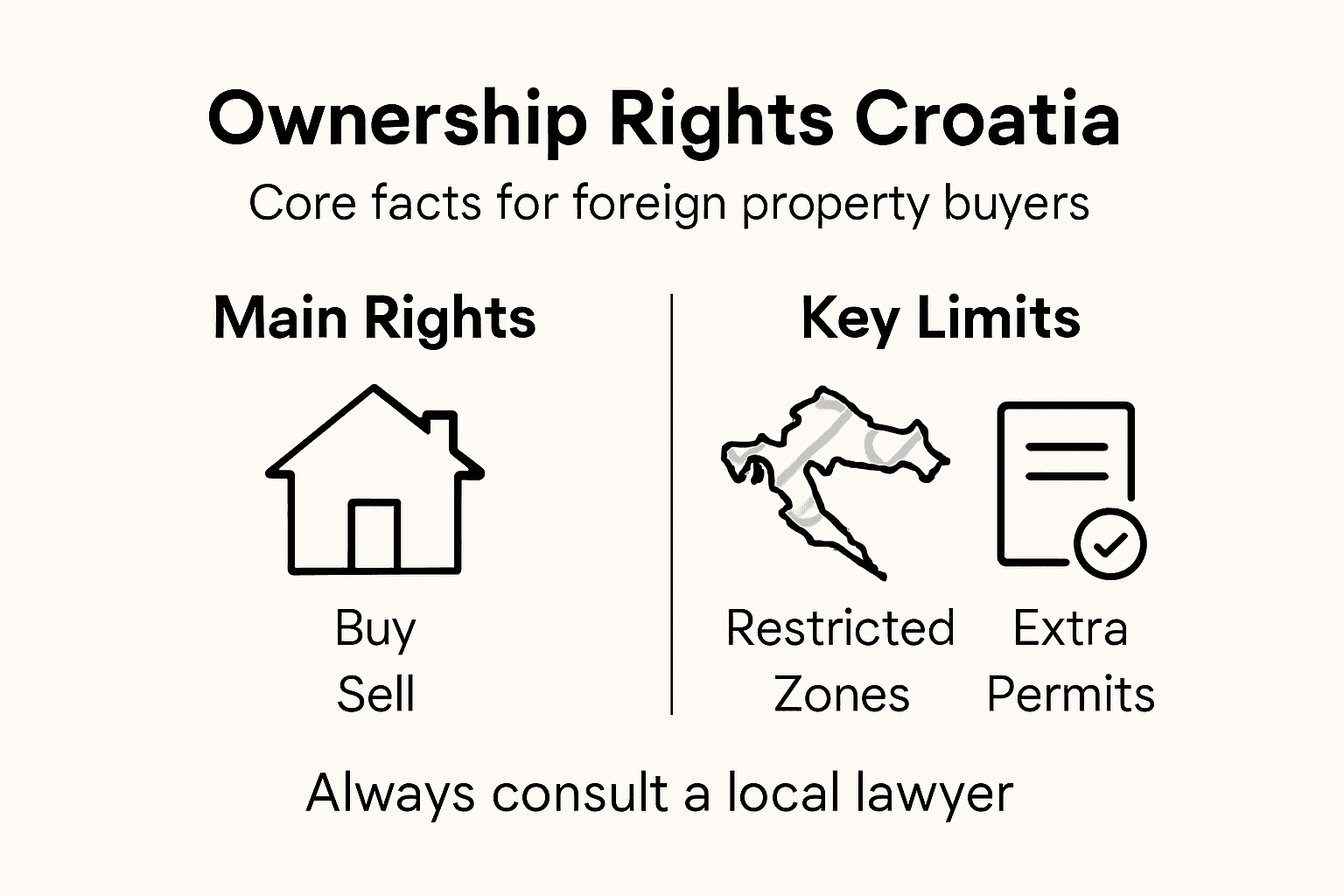
The Croatian legal framework creates distinct purchasing conditions for different categories of foreign buyers. European Union citizens and nationals from OECD countries generally enjoy more straightforward property acquisition processes, often matching the rights of Croatian citizens. Non-EU nationals must typically demonstrate reciprocity, meaning their home country must extend similar property ownership rights to Croatian citizens. Ownership regulations include specific provisions that address variations in property types, with agricultural lands and properties in strategic zones subject to more stringent restrictions and requiring additional ministerial approvals.
Key considerations for foreign buyers include navigating administrative procedures, understanding potential limitations on specific property types, and meeting comprehensive documentation requirements. Some regions impose additional constraints, particularly for agricultural lands, defence-adjacent territories, and properties in environmentally or historically sensitive locations. Ministerial consent remains a critical component of the property acquisition process for many non-EU international investors, requiring thorough documentation and compliance with national regulations.
Pro tip: Engage a local Croatian real estate lawyer specializing in international property transactions to meticulously review your specific situation and ensure complete compliance with current foreign ownership regulations.
Foreign property buyers in Croatia face different requirements depending on their national origin. Here is a comparative overview:
| Buyer Category | Acquisition Pathway | Typical Restrictions | Special Approvals Needed |
|---|---|---|---|
| EU Citizens | Similar rights as Croatians | Few restrictions, mostly open market | Rarely required |
| OECD Nationals | Simplified purchase process | Some limits on agricultural or strategic land | Occasionally required |
| Non-EU Nationals | Reciprocity and documentation required | Strict limits on certain property types | Ministerial consent often needed |
Acquisition Process and Due Diligence Steps
Successfully purchasing property in Croatia demands a meticulous approach to due diligence that goes far beyond simple financial considerations. Ownership registration procedures are complex, requiring comprehensive documentation and careful navigation of legal requirements that protect both buyers and existing property owners.
The acquisition process typically involves several critical steps for foreign investors. Initial verification is paramount, which includes obtaining a comprehensive title search to confirm the property’s legal status, checking for any existing encumbrances, and verifying the seller’s legitimate ownership rights. Foreign ownership procedures mandate thorough documentation, including proving reciprocity, obtaining necessary ministerial approvals, and ensuring all legal requirements are precisely met. Potential buyers must secure a valid purchase agreement, have it translated and notarized, and prepare for potential additional administrative requirements specific to their national origin.
Navigating the Croatian property acquisition landscape requires understanding that legal ownership is not automatically transferred upon signing a purchase agreement. The land registry plays a crucial role in officially recognizing property transfers, meaning buyers must submit comprehensive documentation to complete the registration process. This includes providing proof of payment, tax identification, valid identification documents, and potentially obtaining specific permits depending on the property type and the buyer’s national status. Potential challenges can arise from historical property disputes, unresolved inheritance issues, or complex ownership structures that require expert legal intervention.
Pro tip: Hire a local Croatian real estate lawyer who specializes in international property transactions to conduct a comprehensive due diligence investigation and manage the entire registration process, ensuring all legal requirements are meticulously fulfilled.
Obligations, Risks, and Tax Considerations
Owning property in Croatia involves a complex landscape of financial and legal responsibilities that foreign investors must carefully navigate. Property rights obligations encompass far more than simple ownership, requiring comprehensive understanding of local regulations, tax structures, and potential legal liabilities that can significantly impact investment outcomes.
Tax considerations represent a critical aspect of property ownership in Croatia. Property transfer tax typically ranges between 3-5% of the property’s market value, with foreign investors subject to specific calculation methods. Legal tax implications include multiple taxation streams: annual real estate taxes, potential income taxes from rental properties, and capital gains taxes for property sales. Foreign owners must also account for additional administrative fees, registration costs, and potential municipal levies that can substantially increase the overall financial commitment.
Significant risks emerge from potential regulatory changes, zoning restrictions, and complex legal interpretations that can impact property value and usage rights. Investors must be prepared for potential challenges such as land use restrictions, environmental regulations, historical preservation requirements, and potential compulsory purchase scenarios involving public interest. Unresolved property disputes, unclear inheritance histories, or undocumented easements can create substantial legal complications that may require extensive legal intervention and financial resources to resolve.
Pro tip: Retain a local Croatian tax advisor and legal professional who specializes in international property investments to conduct a comprehensive risk assessment and develop a strategic tax planning approach specific to your property ownership scenario.
Secure Your Croatian Property Investment with Expert Guidance
Navigating ownership rights in Croatia can be daunting, especially for foreign buyers facing complex regulations around property types, foreign national requirements, and due diligence steps. The article highlights key challenges such as understanding reciprocity rules, managing restrictions on agricultural or strategic lands, and completing rigorous registration procedures. If you seek clarity and confidence while entering Croatia’s real estate market, expert support becomes essential to avoid costly errors and legal pitfalls.
At 385 Real Estate, we specialise in representing international clients who want to buy or sell property across Croatia. Our team offers tailored services including comprehensive property searches, market insights, and meticulous guidance on legal ownership nuances important for foreign buyers. Learn more about how we can help you navigate Croatian property laws by visiting our website. Make your investment journey smooth and secure with trusted local expertise. Start your search and get personalised assistance today at 385 Real Estate.
Frequently Asked Questions
What are the key ownership rights for foreign buyers in Croatia?
Foreign buyers in Croatia enjoy certain rights under the constitutional framework, including property acquisition related to specific conditions, especially for EU citizens, who often have the same rights as Croatian nationals.
Are there specific restrictions for foreign property ownership in Croatia?
Yes, there are restrictions depending on the property type and region. Areas such as agricultural lands and properties in strategic locations may require additional approvals and have stricter regulations for foreign buyers.
What steps should foreign buyers take during the property acquisition process in Croatia?
Foreign buyers should conduct due diligence, including obtaining a title search, verifying ownership rights, and ensuring compliance with legal requirements. It’s advisable to work with a local real estate lawyer to navigate the process successfully.
What are the tax implications for foreign property owners in Croatia?
Foreign property owners may be subject to property transfer taxes ranging from 3-5% of the market value, as well as annual real estate taxes, income taxes from rental properties, and capital gains taxes for property sales.
Recommended
- Can Foreigners Buy Property in Croatia? Complete 2025 Guide – 385 Real Estate
- Ultimate Buyer’s Guide: How to Buy Property in Croatia – 385 Real Estate
- Can US Citizens Buy Property in Croatia? Complete 2025 Guide for Americans – 385 Real Estate
- Ultimate Seller’s Guide: How to Sell Your Property in Croatia – 385 Real Estate