
Vacation Homes in Croatia: Secure Investment Potential

Most Canadian investors now look to Croatia for luxury vacation homes that offer both personal retreat and impressive returns. With over 35 percent of international buyers coming from Western Europe or North America, the Croatian coastline is no longer just a hidden gem. Understanding the distinctions between vacation properties, legal frameworks, and investment strategies can give you a clear edge in securing a safe and profitable spot in this fast-developing market.
Table of Contents
- Defining Vacation Homes in Croatia
- Key Types and Popular Destinations
- Legal Rules for Foreign Ownership
- Financial Considerations and New Taxes
- Risks, Insurance, and Common Pitfalls
- Comparing Croatia to Other Holiday Markets
Key Takeaways
| Point | Details |
|---|---|
| Investment Potential | Croatia offers diverse vacation home types with strong rental potential and unique appeal. |
| Property Ownership Regulations | Foreign investors should understand the complexities of ownership laws based on nationality. |
| Financial Considerations | Comprehensive tax planning is essential to navigate property taxes and maximise returns. |
| Market Positioning | Croatia presents a less saturated market compared to other Mediterranean destinations, enhancing investment opportunities. |
Defining Vacation Homes in Croatia
Vacation homes in Croatia represent a unique real estate category with deep historical roots and significant economic implications. These properties, often situated in picturesque coastal and island regions, are distinct from primary residences and play a crucial role in the country’s tourism infrastructure. Historically documented expansions in second home ownership reveal that these properties have been transforming local settlements for decades.
In the Croatian context, vacation homes are residential properties primarily used for leisure, recreation, and seasonal occupation. They differ from permanent dwellings in several key aspects: location, usage patterns, and investment potential. Typically concentrated in tourism-rich areas like Dalmatia, Istria, and the Croatian islands, these properties serve multiple functions – from personal retreats to income-generating rental assets. The strategic positioning near coastal attractions makes them particularly appealing to both domestic and international buyers.
Research indicates that vacation homes constitute a significant portion of Croatia’s housing stock, with unique socio-economic characteristics. Recent census data shows these properties have experienced nuanced demographic shifts, reflecting changing ownership trends and evolving tourism dynamics. While traditionally concentrated in coastal regions, modern vacation homes now represent sophisticated investment vehicles that blend personal enjoyment with potential financial returns.
Pro tip: When considering a Croatian vacation home, prioritize properties in regions with established tourism infrastructure and proven rental potential to maximize both personal enjoyment and investment returns.
Key Types and Popular Destinations
Croatia’s vacation home landscape encompasses diverse property types catering to different investor preferences and lifestyle needs. Coastal counties like Dubrovnik-Neretva, Split-Dalmatia, and Istria represent the most sought-after regions for holiday properties, offering unique investment opportunities across multiple property categories.
The primary vacation home types in Croatia can be classified into several distinct segments:
- Traditional Stone Houses: Predominantly found in Dalmatian coastal towns and islands, these historic properties offer authentic architectural charm and potential for high-end restoration projects
- Modern Apartments: Located in tourist hotspots like Rovinj, Split, and Dubrovnik, these properties provide turnkey investment opportunities with strong rental potential
- Standalone Villas: Typically situated in premium locations with sea views, these properties represent the high-end segment of the vacation home market
- Rustic Countryside Homes: Located in inland regions like Zagorje and Slavonia, offering more affordable options with significant renovation potential
Each property type presents unique advantages for international investors. Coastal properties in regions like Istria and Dalmatia demonstrate consistently strong performance, with strategic locations near tourism infrastructure creating robust rental markets. Urban apartments in historic cities like Dubrovnik and Split offer excellent short-term rental potential, while rural properties provide opportunities for more immersive, long-term investment strategies.
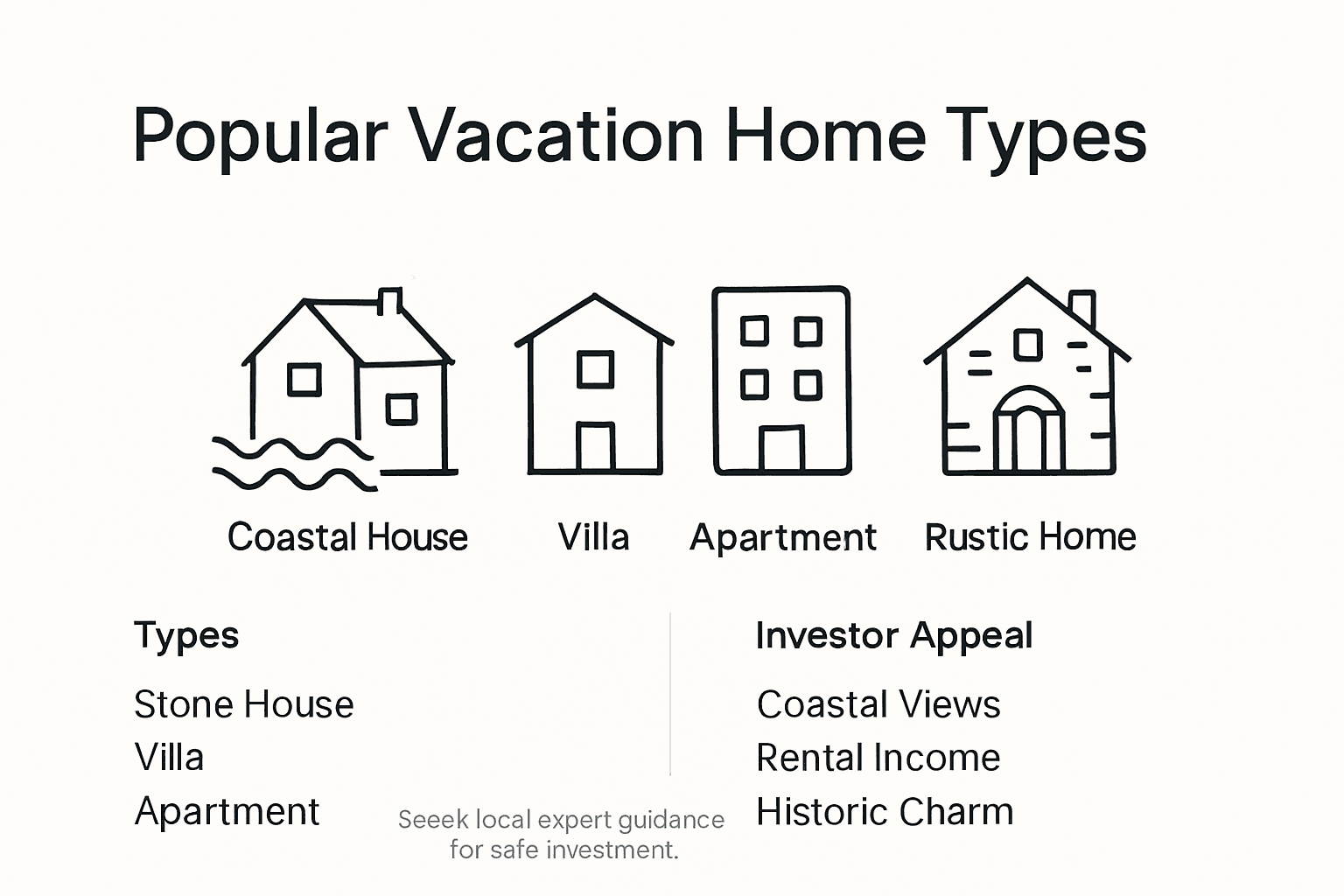
Here’s a summary of the main vacation home types and their investment highlights in Croatia:
| Vacation Home Type | Typical Location | Investor Appeal |
|---|---|---|
| Traditional Stone House | Dalmatian towns/islands | High restoration value, unique charm |
| Modern Apartment | Major tourist cities | Strong rental demand, hassle-free |
| Standalone Villa | Coastal premium areas | Exclusive use, high appreciation potential |
| Rustic Countryside Home | Inland regions | Lower entry cost, renovation opportunity |
Pro tip: Consider working with local real estate professionals who understand micromarket dynamics to identify vacation home opportunities that align with your specific investment goals and risk tolerance.
Legal Rules for Foreign Ownership
Foreign property ownership in Croatia involves nuanced legal frameworks that differ significantly based on an investor’s nationality and specific property characteristics. Non-EU citizens must navigate more complex approval processes through the Ministry of Justice, requiring careful legal preparation and documentation to successfully acquire vacation properties.
The legal landscape for foreign property ownership can be broken down into two primary categories:
- EU Citizens: Generally enjoy streamlined property acquisition rights with minimal additional restrictions
- Non-EU Citizens: Required to obtain specific ministerial approvals and meet additional legal requirements
- Reciprocity Principle: Some countries have bilateral agreements that simplify property acquisition based on mutual legal recognition
Recent regulatory changes have introduced more sophisticated controls around property usage and rental operations. New legal frameworks now mandate stricter consent requirements for holiday rentals, particularly in multi-dwelling buildings, which can impact foreign investors’ operational strategies. These regulations aim to balance residential zone protections with tourism development, creating a more structured environment for international property investments.
Foreign investors must also consider additional legal considerations such as tax obligations, residency implications, and potential restrictions on property types or locations. Comprehensive due diligence, preferably with local legal counsel specializing in international real estate transactions, becomes crucial for navigating these complex regulatory environments.
Pro tip: Engage a Croatian legal specialist who understands international property law to conduct a comprehensive review of your specific ownership scenario before finalizing any property investment.
Financial Considerations and New Taxes
Investing in Croatian vacation homes requires a comprehensive understanding of the complex financial landscape, including taxation, operational costs, and potential revenue streams. Annual property taxes are calculated based on the usable floor area, ranging from 0.66 to 1.99 EUR per square meter as determined by local municipalities, creating a nuanced financial obligation for property owners.
Key financial considerations for potential vacation home investors include:
- Property Tax Obligations: Variable rates depending on location and property size
- Rental Income Potential: Significant revenue opportunities in high-tourism regions
- Maintenance Costs: Ongoing expenses for property upkeep and management
- Currency Exchange Fluctuations: Potential financial impacts for international investors
The Croatian tax system introduces several critical financial dimensions for foreign property owners. Investors must navigate not only standard property taxes but also potential income tax implications from rental activities, value-added tax (VAT) considerations, and potential capital gains taxation. The complexity increases for non-resident owners, who may face additional reporting requirements and potential withholding tax obligations.
Strategic financial planning becomes paramount, with investors needing to consider both immediate costs and long-term investment potential. This includes evaluating potential rental yields, understanding local tax incentives, and developing a comprehensive financial model that accounts for property appreciation, maintenance expenses, and potential market fluctuations.
Pro tip: Consult with a Croatian tax specialist who understands international investment structures to develop a comprehensive financial strategy that optimizes your tax position and maximizes investment returns.
Risks, Insurance, and Common Pitfalls
Owning a vacation home in Croatia involves navigating a complex landscape of potential risks and regulatory challenges that can significantly impact investment success. Property owners must carefully manage legal compliance, particularly in registration and taxation of rental income, with specific attention to neighborhood agreements in multi-dwelling buildings, as regulatory missteps can lead to substantial financial penalties.
Key risk categories for vacation home investors include:
- Regulatory Compliance Risks: Potential permit revocation or legal complications
- Financial Exposure: Unexpected taxation changes or income limitations
- Property Management Challenges: Maintenance and occupancy-related issues
- Insurance Coverage Gaps: Potential underinsurance for specific regional risks
Recent regulatory changes have heightened the complexity of vacation home ownership, with new laws introducing stricter requirements for rental permissions and neighbor consent. International investors must develop a comprehensive risk management strategy that includes detailed legal consultation, robust insurance coverage, and proactive compliance monitoring. This approach involves understanding local regulations, maintaining accurate documentation, and developing contingency plans for potential regulatory shifts.
Insurance strategies become crucial in mitigating potential financial risks. Investors should seek specialized insurance products that cover unique vacation home scenarios, including seasonal occupancy risks, potential natural disaster impacts, and liability protection. Comprehensive coverage should address property damage, loss of rental income, and potential legal expenses associated with property management.
Pro tip: Engage a local Croatian insurance specialist who understands the nuanced risks of vacation home ownership to develop a tailored insurance strategy that comprehensively protects your investment.
Comparing Croatia to Other Holiday Markets
Comparative analysis of vacation home markets reveals Croatia’s unique positioning within European real estate investment landscapes. Unlike more saturated markets like Spain or Greece, Croatia offers distinctive advantages: pristine coastlines, emerging tourism infrastructure, and relatively lower property acquisition costs, which create compelling investment opportunities for discerning international buyers.
Key comparative market characteristics include:
- Mediterranean Competition: Croatia offers more competitive pricing compared to established markets like Italy and France
- Regulatory Environment: Less complex ownership rules compared to countries with stringent foreign investment restrictions
- Tourism Growth Potential: Higher projected tourism expansion rates versus traditional European holiday destinations
- Investment Appreciation: Emerging market with stronger potential for property value appreciation
The Croatian vacation home market demonstrates several strategic differentiators from other European holiday destinations. While markets in Spain and Portugal have experienced significant price stabilization, Croatia continues to offer more dynamic investment potential. The combination of limited coastal property availability, increasing international tourism interest, and relatively accessible ownership regulations creates a uniquely attractive investment environment.
Investors comparing Croatia against other Mediterranean markets will find nuanced advantages: lower entry costs, significant tourism growth potential, and a less saturated real estate landscape. Strategic buyers recognize that Croatia represents an emerging opportunity, with potential for both personal enjoyment and robust financial returns that may outperform more established holiday home markets.
This table compares crucial factors for vacation home investments in Croatia and three major Mediterranean markets:
| Factor | Croatia | Spain | Italy |
|---|---|---|---|
| Entry Cost | Generally lower | Moderate to high | High |
| Regulatory Complexity | Moderate | Moderate | High |
| Tourism Growth Rate | Strong | Stable | Stable |
| Foreign Ownership | Broadly accessible | Widely open | Often complex |
| Market Saturation | Low to medium | High | Very high |
Pro tip: Conduct comprehensive comparative market research by consulting local real estate experts who can provide granular insights into regional investment variations and emerging opportunities.
Discover Your Ideal Vacation Home with Expert Guidance from 385 Real Estate
Navigating the complex landscape of vacation homes in Croatia means understanding local legal frameworks, financial nuances, and emerging market trends. Whether you are seeking a traditional stone house in Dalmatia or a modern apartment in Split, addressing challenges such as foreign ownership regulations, rental compliance, and investment risks is essential. At 385 Real Estate, we specialise in helping international clients unlock the full potential of Croatian vacation properties by providing tailored insights and dedicated support.
Explore our comprehensive property listings and benefit from our deep local knowledge to seize secure investment opportunities in Croatia’s most sought-after destinations. Act now to secure expert advice on legal requirements, market dynamics, and financial planning. Visit 385 Real Estate to begin your seamless journey towards owning the perfect vacation home. Learn more about how we guide foreign investors by visiting our homepage and take the first step towards a confident property purchase today.
Frequently Asked Questions
What are vacation homes in Croatia?
Vacation homes in Croatia are residential properties primarily used for leisure, recreation, and seasonal occupation, often located in picturesque areas with high tourism potential.
What are the primary types of vacation homes available in Croatia?
The main types of vacation homes include traditional stone houses, modern apartments, standalone villas, and rustic countryside homes, each catering to different investment strategies and lifestyle preferences.
What are the legal considerations for foreign investors buying vacation homes in Croatia?
Foreign investors must navigate specific legal frameworks that differ based on nationality, including obtaining permissions from local authorities, particularly for non-EU citizens, as well as ensuring compliance with local regulations regarding property use.
How do financial obligations, such as taxes, affect vacation home investments in Croatia?
Investors must consider various financial obligations, including property taxes based on usable floor area, rental income taxes, and potential currency fluctuations, all of which can impact the overall profitability of vacation home investments.