
Real Estate Terminology Croatia – Key For Foreign Investors
Most foreign buyers are surprised to learn that Canadian and other non-European investors face extra steps when buying real estate in Croatia. Understanding the subtle differences in Croatian property terms can save significant time and money during the purchase process. This guide breaks down essential Croatian real estate vocabulary, helping Canadian expatriates and international investors avoid costly confusion and make informed decisions about their property transactions.
Table of Contents
- Core Croatian Real Estate Terms Defined
- Property Ownership Types And Distinctions
- Legal Requirements For Foreign Buyers
- Essential Documents And Registration Process
- Costs, Taxes, And Common Buyer Errors
- Terminology Around Rights And Restrictions
Key Takeaways
| Point | Details |
|---|---|
| Understand Legal Terminology | Familiarise yourself with essential Croatian real estate terms like Nekretnina and Vlasnik to navigate property transactions effectively. |
| Reciprocity Principle | Verify your national status regarding property ownership rights, as they differ for Croatian citizens, EU nationals, and third-country nationals. |
| Documentation Requirements | Prepare comprehensive documentation, including a reciprocity certificate and Personal Identification Number, before initiating any property transaction. |
| Financial Planning | Anticipate additional costs of 10-15% above the property price for taxes and fees to avoid unexpected financial burdens during the purchase process. |
Core Croatian Real Estate Terms Defined
Navigating the Croatian real estate market requires understanding key terminology specific to the local context. Foreign investors must familiarise themselves with fundamental terms that govern property transactions and ownership structures in Croatia. Understanding property rights and administrative requirements becomes crucial for successful investment strategies.
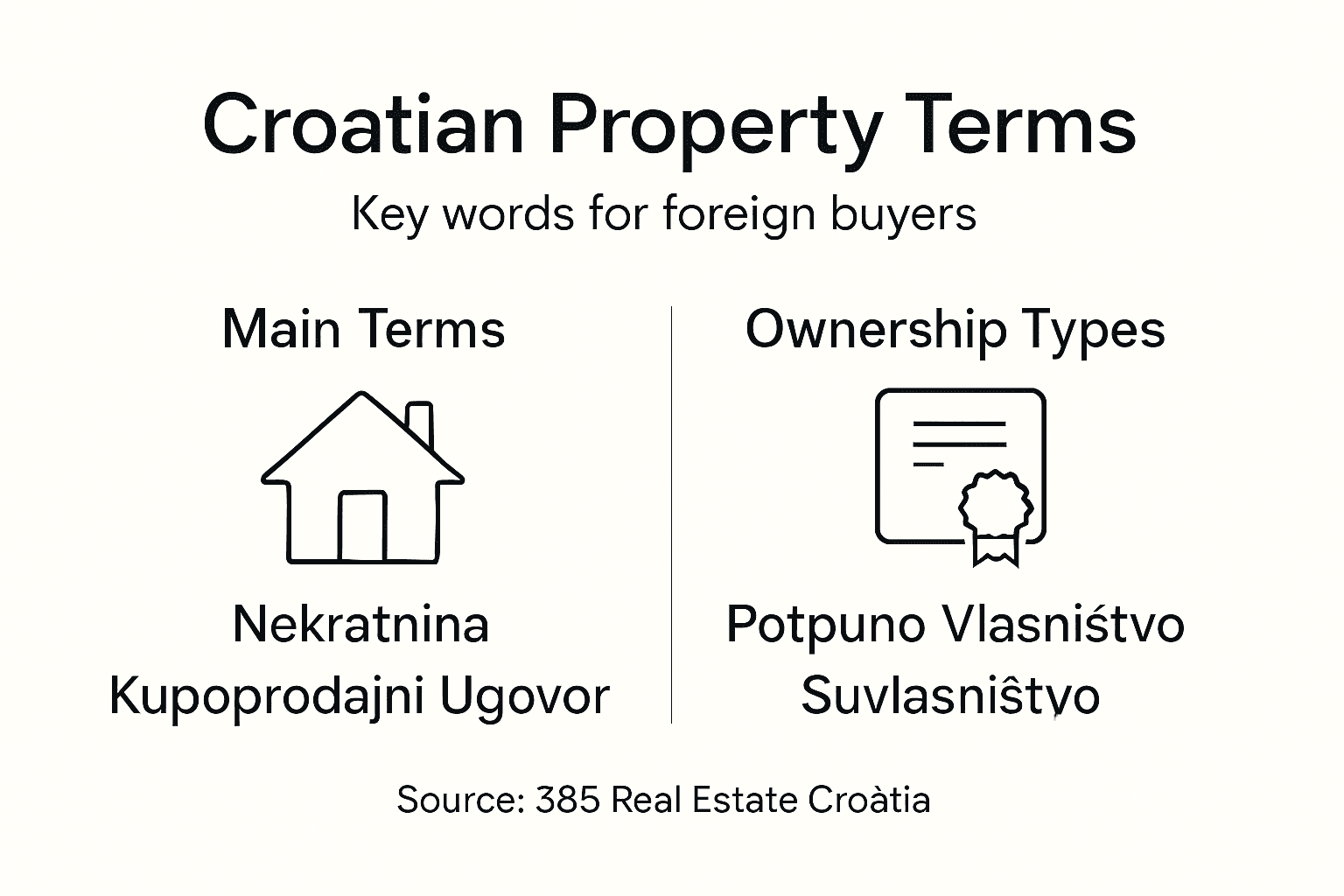
Several core Croatian real estate terms demand careful attention. Nekretnina represents the general term for real estate or property, while vlasnik indicates the property owner. Kupoprodajni ugovor refers to the property purchase agreement, a critical legal document that outlines transaction details. Foreign buyers should note that property acquisition often depends on the principle of reciprocity, which determines whether citizens from a specific country can purchase real estate under equivalent conditions.
Ownership structures in Croatia include several distinct categories. Suvlasništvo describes shared ownership, where multiple parties possess proportional rights to a property. Etažno vlasništvo specifically refers to apartment ownership, defining individual unit ownership within a larger building complex. For foreign investors, understanding these nuanced terms helps prevent potential legal misunderstandings and ensures smoother property transactions.
Pro tip: Always engage a local legal professional who specializes in Croatian real estate to help translate and interpret complex terminology during your property acquisition process.
Property Ownership Types And Distinctions
Croatian property ownership presents a complex landscape for foreign investors, with distinct legal frameworks governing different categories of property acquisition. Property ownership rights vary significantly based on national origin and reciprocity agreements, creating nuanced challenges for international buyers seeking real estate investments.
Foreign investors encounter three primary ownership categories in Croatia. Croatian citizens enjoy unrestricted property ownership rights, while European Union nationals benefit from essentially equivalent purchasing privileges. Third-country nationals face more restrictive conditions, with property acquisition dependent on bilateral reciprocity agreements between Croatia and their home country. This means potential investors must carefully verify their specific national standing before initiating any property transaction.

The legal structure distinguishes between several critical ownership types. Potpuno vlasništvo represents full ownership rights, granting complete control and use of a property. Suvlasništvo indicates shared ownership, where multiple parties hold proportional property rights. Etažno vlasništvo specifically relates to apartment or unit ownership within a larger complex, defining individual ownership boundaries within collective property structures.
Here is a summary of key Croatian property ownership types and their main characteristics:
| Ownership Type | Description | Typical Usage |
|---|---|---|
| Full ownership (Potpuno vlasništvo) | Complete control and use of property | Houses, villas, land |
| Shared ownership (Suvlasništvo) | Multiple parties own proportional shares | Multi-family homes, land |
| Apartment ownership (Etažno vlasništvo) | Own individual unit within a complex | Condominiums, flats |
Pro tip: Consult with a Croatian legal specialist who can comprehensively assess your specific national status and potential property ownership restrictions before initiating any real estate investment.
Legal Requirements For Foreign Buyers
Legal requirements for foreign property buyers in Croatia present a complex regulatory landscape that demands meticulous understanding and preparation. Foreign nationals must navigate a series of specific legal provisions that differ substantially based on their country of origin, national status, and existing bilateral agreements.
The cornerstone of foreign property acquisition in Croatia is the principle of reciprocity. This legal mechanism determines whether citizens from a specific country can purchase real estate under equivalent conditions as Croatian nationals. European Union citizens enjoy significantly more straightforward acquisition processes, essentially experiencing the same property purchasing rights as Croatian citizens. Non-EU foreign buyers, however, must demonstrate reciprocal property ownership rights in their home countries, which requires obtaining official documentation and administrative approvals from Croatian governmental authorities.
Specific documentation requirements are crucial for foreign investors. Prospective buyers must prepare a comprehensive portfolio including passport copies, proof of legal residence, financial statements, and a dokaz o reciprocitetu (reciprocity certificate). The Ministry of Justice typically evaluates these submissions, assessing both individual eligibility and broader national legal compatibility. Additionally, foreign buyers must obtain an Osobni identifikacijski broj (Personal Identification Number) from Croatian tax authorities, which is essential for completing property transactions and managing subsequent legal and financial obligations.
Pro tip: Engage a local Croatian real estate lawyer specializing in foreign property transactions to meticulously review your documentation and ensure complete compliance with national legal requirements before initiating your property purchase.
Essential Documents And Registration Process
Navigating the complex documentation requirements for property registration in Croatia demands precise attention to administrative protocols, with foreign investors needing to compile a comprehensive portfolio of legal and financial documents. The registration process involves multiple governmental agencies and requires systematic preparation of specific paperwork to ensure successful property acquisition.
The essential document collection typically includes several critical components. Investors must prepare original passport copies, proof of legal residence, detailed financial statements, and a tax identification number. The kupoprodajni ugovor (property purchase agreement) serves as the foundational legal document, which must be professionally translated and notarized. Foreign buyers will need to obtain a dokaz o reciprocitetu (reciprocity certificate) from the Ministry of Justice, demonstrating their eligibility to purchase real estate in Croatia.
The registration process follows a structured sequence of administrative steps. After securing the purchase agreement, buyers must submit documentation to the local land registry (Zemljišnoknjižni sud) for official property transfer. This involves registering the property deed, paying associated transfer taxes, and obtaining an Extract from the Land Registry that confirms official ownership transfer. Non-Croatian citizens must additionally provide evidence of meeting reciprocity requirements, which may involve obtaining approvals from multiple governmental departments.
Pro tip: Retain multiple certified document copies and maintain a comprehensive digital and physical file throughout the registration process to expedite bureaucratic procedures and prevent potential administrative complications.
Costs, Taxes, And Common Buyer Errors
Foreign investors must carefully navigate the complex financial landscape of Croatian real estate transactions, which involves multiple taxation layers and potential financial pitfalls. Understanding the intricate cost structure is crucial for preventing unexpected financial burdens and ensuring a smooth property acquisition process.
The primary tax considerations include several key financial obligations. Real estate transfer tax typically ranges between 3-5% of the property’s market value, with rates varying depending on specific regional regulations. Value Added Tax (VAT) of 25% applies to new property constructions, while resale properties are generally exempt. Foreign buyers should anticipate additional expenses such as notary fees, legal consultation costs, and administrative registration charges, which can collectively amount to approximately 5-7% of the total property value.
The table below contrasts property tax and cost responsibilities for foreign buyers in Croatia:
| Cost Type | Who Pays | Typical Rate/Amount |
|---|---|---|
| Real estate transfer tax | Buyer | 3-5% of property value |
| Value Added Tax (VAT) | Buyer of new build | 25% on new construction |
| Notary/legal fees | Buyer | 1-3% of property value |
| Registration charges | Buyer | 1-2% of property value |
Common buyer errors often stem from inadequate due diligence and financial preparation. Frequent mistakes include failing to verify complete property ownership documentation, overlooking potential hidden legal encumbrances, and underestimating total transaction costs. Some foreign investors mistakenly assume that listing prices represent the total expenditure, neglecting to budget for substantial additional expenses like property transfer taxes, legal fees, and potential renovation costs. Comprehensive financial planning and engaging local legal expertise can mitigate these potential risks and prevent costly misunderstandings.
Pro tip: Budget an additional 10-15% above the listed property price to cover all potential transaction expenses, taxes, and unexpected administrative costs during your Croatian real estate purchase.
Terminology Around Rights And Restrictions
Property rights and restrictions in Croatia represent a nuanced legal framework that foreign investors must comprehensively understand, with specific terminology defining the boundaries of ownership and potential limitations on real estate transactions.
Critical legal concepts include servitude (poslužno pravo), which defines specific rights allowing one property to benefit from another, such as access rights or utility easements. Usufruct (pravo uživanja) represents another essential term, granting temporary usage rights without full ownership transfer. Foreign investors must also navigate complex encumbrance restrictions, which may limit property development, include historical preservation requirements, or mandate specific land-use protocols that can significantly impact investment potential.
The Croatian legal system distinguishes between several ownership restriction categories. Prostorno planirani uvjeti refers to urban planning conditions that dictate potential property modifications, while zakonska ograničenja represents statutory limitations imposed by national regulations. These restrictions can include environmental protection zones, archaeological site considerations, coastal development limitations, and specific zoning regulations that may prevent certain types of construction or property transformation. Non-Croatian investors particularly need to understand these nuanced legal constraints, which can materially affect property value and potential investment returns.
Pro tip: Engage a local Croatian real estate lawyer to conduct a comprehensive legal review of potential property restrictions before finalizing any purchase, ensuring you fully understand all limitations and potential development constraints.
Master Croatian Real Estate Terminology with Expert Guidance
Understanding the complex legal terms like kupoprodajni ugovor, etažno vlasništvo, and the principle of reciprocity can be overwhelming for foreign investors looking to buy property in Croatia. The challenges of navigating ownership restrictions and legal requirements are common pain points that can turn an exciting investment opportunity into a stressful process. With so many critical steps including document preparation, registration protocols, and tax obligations, having expert insights is essential for a seamless experience.
At 385 Real Estate, we specialize in simplifying these complexities for international buyers. Our team offers personalised support that goes beyond property listings to include clear explanations of Croatian real estate terminology and tailored advice on regulations affecting your ownership rights. Whether you are searching for a vacation home or a long-term investment, our comprehensive services help you avoid costly mistakes and give you confidence at every stage.
Discover how we bridge the gap between Croatian legalese and your real estate goals. Explore our expert guidance and curated properties today.
Ready to turn Croatian property challenges into opportunities? Visit 385 Real Estate to connect with specialists who speak your language and understand your needs. Start your journey with clear knowledge and trusted local support now.
Frequently Asked Questions
What is the meaning of nekretnina in Croatian real estate?
Nekretnina is the general term for real estate or property in Croatia, encompassing all types of properties including residential and commercial.
What are the different types of property ownership in Croatia?
In Croatia, property ownership types include full ownership (potpuno vlasništvo), shared ownership (suvlasništvo), and apartment ownership (etažno vlasništvo). Each type has its own legal implications and usage conditions.
What is the principle of reciprocity in property acquisition?
Reciprocity is a legal principle determining whether foreign nationals can purchase property based on similar ownership rights available in their home countries. This affects property acquisition for non-EU citizens significantly.
What essential documents are required for foreign buyers in Croatian real estate transactions?
Foreign buyers need to prepare several essential documents, including passport copies, proof of legal residence, financial statements, a reciprocity certificate, and a Personal Identification Number (PIN) from Croatian tax authorities.
Recommended
- Can Foreigners Buy Property in Croatia? Complete 2025 Guide – 385 Real Estate
- Ultimate Buyer’s Guide: How to Buy Property in Croatia – 385 Real Estate
- Croatia Real Estate Market Slowdown 2025: Buyer’s Guide for Foreign Investors
- Ultimate Seller’s Guide: How to Sell Your Property in Croatia – 385 Real Estate
- Yigal Realty