
Property Valuation in Croatia: Key Steps and Legal Insights
Property valuation in Croatia involves a level of scrutiny that many Canadian investors might find unfamiliar. Strict legal guidelines and transparent assessment standards set Croatian real estate apart from other European markets. For foreign buyers seeking a secure investment or a luxury vacation home, understanding these processes is essential. This guide breaks down the important valuation methods, legal requirements, and the role of certified experts, providing clarity for high-net-worth individuals interested in Croatia’s dynamic property opportunities.
Table of Contents
- Property Valuation In Croatia Explained
- Major Valuation Methods And When They Apply
- Legal Requirements For Foreign Property Owners
- Role Of Licensed Valuers And Market Transparency
- Common Pitfalls And Financial Implications
Key Takeaways
| Point | Details |
|---|---|
| Importance of Certified Valuers | Engaging certified court expert witnesses is crucial for accurate property valuations in Croatia, ensuring compliance with the Property Valuation Act of 2015. |
| Valuation Methods | Familiarise yourself with the three primary valuation methods: comparative, income, and replacement cost, to understand how property values are determined. |
| Legal Requirements for Foreign Investors | Foreign property ownership involves navigating complex regulations; it is essential to engage a local legal professional for compliance and proper guidance. |
| Avoiding Valuation Pitfalls | Conduct thorough due diligence to avoid common pitfalls like relying on asking prices, which can lead to significant financial impacts in property transactions. |
Property Valuation in Croatia Explained
Property valuation in Croatia represents a sophisticated legal and financial process governed by stringent regulations. The Property Valuation Act of 2015 established comprehensive guidelines that ensure transparency and accuracy in determining real estate market values across the country.
Certified court expert witnesses play a critical role in Croatian property assessment. These professionals follow meticulously defined procedures when evaluating residential, commercial, and investment properties. They analyse multiple factors including location, infrastructure, current market conditions, property condition, and comparative sales data to determine an accurate market value. The Real Estate Valuation Act mandates that these experts conduct assessments with exceptional diligence, ensuring each valuation reflects sustainable and realistic market conditions.
Foreign investors should understand that Croatian property valuations are not simply mechanical calculations but comprehensive analyses. Valuers consider intricate details such as neighbourhood development potential, proximity to amenities, historical property performance, and regional economic trends. The government’s eNekretnine platform provides certified valuers with comprehensive market data, enhancing the precision of their assessments and contributing to a transparent real estate ecosystem.
Pro tip: When purchasing property in Croatia, always request an independent valuation from a court-certified expert to confirm the property’s true market value and protect your investment.
Major Valuation Methods and When They Apply
Croatian property valuation is structured around comprehensive methodological standards that incorporate both local and international approaches. Valuers must select appropriate techniques depending on the specific property type, location, and intended assessment purpose. These methodological frameworks ensure consistent and accurate market value determinations across different real estate categories.
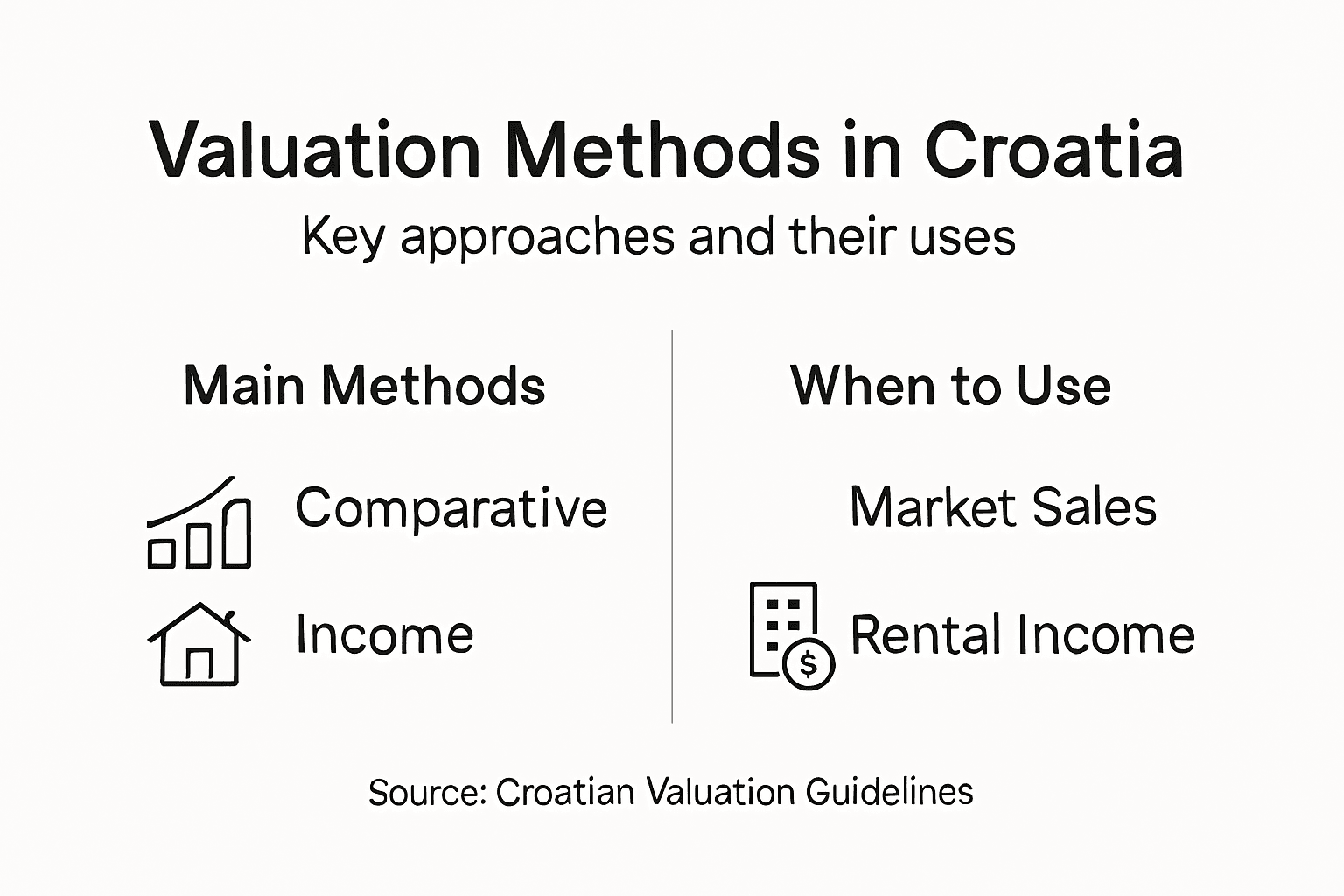
The three primary valuation methods employed in Croatia include the comparative approach, income approach, and replacement cost approach. The comparative method involves analysing recent sales of similar properties in the same geographic area, adjusting for unique characteristics like size, condition, and amenities. This approach works best for residential properties and standard commercial spaces with numerous comparable market transactions. The income approach proves particularly effective for investment properties, calculating potential revenue generation by examining current rental rates, occupancy levels, and potential future earnings.
The replacement cost method focuses on determining how much it would cost to construct an equivalent property from scratch, considering current construction prices, land value, and depreciation. This technique is especially useful for unique properties or those with limited comparable sales data. Government regulations mandate that certified valuers document their methodology thoroughly, ensuring transparency and allowing for potential review or challenge of the valuation.
Here is a comparison of the three primary property valuation methods used in Croatia:
| Method | Best For | Key Strength | Main Limitation |
|---|---|---|---|
| Comparative | Residential, standard commercial | Reflects actual sales | Needs sufficient local data |
| Income Approach | Investment and rental properties | Projects earnings | Less accurate for non-income use |
| Replacement Cost | Unique or rarely traded properties | Considers rebuild cost | Does not capture market trends |
Pro tip: Request a detailed valuation report that explicitly explains which method was used and why, providing you with complete insight into how the property’s market value was determined.
Legal Requirements for Foreign Property Owners
Foreign property ownership in Croatia involves navigating a complex legal landscape with specific market participation regulations. Non-Croatian citizens must understand the intricate legal frameworks governing real estate transactions, ownership rights, and compliance requirements. Reciprocity agreements play a crucial role in determining foreign investment eligibility, with different rules applying depending on an investor’s country of origin.

The legal process for foreign property acquisition typically requires extensive documentation and formal approvals. Key requirements include obtaining a residence permit, demonstrating financial stability, and securing necessary permits from local municipal authorities. European Union citizens generally experience fewer restrictions compared to non-EU investors. Critical documentation includes proof of financial capability, clean criminal record, valid identification, and comprehensive property ownership applications that detail the intended use of the real estate.
Taxation represents another significant aspect of legal compliance for foreign property owners. Non-resident investors must register with local tax authorities, understand capital gains tax implications, and maintain accurate financial records. Property transfer taxes, annual property taxes, and potential rental income taxes must be carefully calculated and reported. Some jurisdictions offer tax incentives for long-term investments or property improvements, making thorough legal and financial research essential before completing any real estate transaction.
Pro tip: Engage a local legal professional specializing in international real estate transactions to navigate Croatia’s complex ownership regulations and ensure full compliance with national property laws.
Role of Licensed Valuers and Market Transparency
Licensed valuers represent a critical infrastructure in Croatia’s real estate market, serving as independent professionals who ensure market transparency and accuracy. These certified court experts undergo rigorous training and maintain stringent professional standards that guarantee objective property assessments. Their comprehensive evaluations protect both buyers and sellers by providing reliable, standardized market value determinations based on comprehensive analytical frameworks.
The certification process for valuers in Croatia involves extensive professional qualifications and continuous education requirements. Candidates must demonstrate advanced knowledge of real estate economics, legal frameworks, and analytical methodologies. They are required to pass comprehensive examinations, maintain professional liability insurance, and adhere to strict ethical guidelines that prevent conflicts of interest. The government’s eNekretnine database provides these professionals with access to extensive market data, enabling more precise and contextually informed property valuations.
Market transparency extends beyond individual valuation reports. Licensed valuers contribute to broader economic understanding by generating aggregate market insights, tracking property value trends, and supporting regulatory oversight. Their documented assessments create a traceable record of property transactions, helping to prevent fraudulent activities and providing valuable economic intelligence for policymakers, investors, and financial institutions. This systematic approach ensures that property valuations reflect genuine market conditions and provide reliable information for strategic decision-making.
Pro tip: Always request the professional credentials and certification number of your property valuer to verify their official standing and expertise in the Croatian real estate market.
Common Pitfalls and Financial Implications
Foreign investors and property buyers must carefully navigate the complex landscape of property valuation risks. These risks extend far beyond simple numerical discrepancies, potentially impacting long-term financial strategies and investment outcomes. Misunderstanding or overlooking critical valuation nuances can lead to significant economic consequences that ripple through multiple aspects of property ownership and investment.
The most prevalent pitfalls emerge from relying on misleading market data and incomplete valuation methodologies. Common errors include using asking prices instead of actual transaction values, failing to account for regional economic variations, and neglecting property-specific characteristics that dramatically influence market worth. Foreign investors are particularly vulnerable to these challenges, as they may lack intimate knowledge of local market dynamics. Financial implications can be substantial potential overvaluation might result in excessive property taxes, while undervaluation could compromise loan eligibility and insurance coverage.
The following table summarises common valuation pitfalls and their financial consequences for buyers:
| Pitfall | Potential Impact | Risk Mitigation Strategy |
|---|---|---|
| Using asking prices | Overpaying or overtaxation | Insist on actual sale comparisons |
| Ignoring local market trends | Inaccurate value estimate | Consult local market professionals |
| Incomplete documentation | Delays or legal disputes | Prepare all required paperwork |
Sophisticated investors mitigate these risks through comprehensive due diligence and professional guidance. Key strategies involve obtaining independent professional valuations, thoroughly investigating local market trends, and understanding the intricate legal frameworks governing property assessments. Each valuation requires meticulous examination of comparable sales, infrastructure developments, neighbourhood transformations, and potential future value appreciation. Investors must also consider broader economic indicators, regulatory changes, and geopolitical factors that could influence property valuations.
Pro tip: Engage a local real estate professional with specific expertise in Croatian property markets to conduct a comprehensive risk assessment before finalizing any investment decision.
Navigate Croatian Property Valuation with Expert Guidance
Understanding the complex process of property valuation in Croatia can be daunting especially for foreign investors facing legal and financial challenges. The article highlights critical pain points such as navigating the roles of licensed valuers, choosing the right valuation method, and complying with Croatia’s legal requirements for foreign property ownership. These challenges can create uncertainty and risk around your investment decisions.
At 385 Real Estate, we specialize in helping international buyers and investors overcome these exact hurdles. Our team provides expert market insights and personalised support tailored to your needs so you confidently understand valuation reports and legal nuances. We connect you with court-certified valuers and legal professionals who ensure transparent assessment aligned with local practices mentioned in the article. With curated properties and comprehensive assistance from search to closing available on our main site, we empower you to make informed, secure investments across Croatia.
Discover how our expert guidance turns complicated valuation processes into clear, manageable steps.
Ready to secure an accurate property valuation and navigate Croatian real estate law with confidence?
Explore personalised valuation services and expert market advice today by visiting 385 Real Estate. Let us help you transform uncertainty into opportunity with professional support every step of the way.
Frequently Asked Questions
What are the primary methods used for property valuation in Croatia?
The three primary methods for property valuation in Croatia include the comparative approach, income approach, and replacement cost approach. Each method is chosen based on the property type, location, and purpose of the assessment.
Why is it important to have an independent property valuation in Croatia?
An independent property valuation ensures that the market value of a property is accurately represented, protecting buyers from overpaying and helping sellers establish a fair price. It also aids in obtaining loans or insurance.
What legal requirements must foreign property owners in Croatia meet?
Foreign property owners must obtain a residence permit, demonstrate financial stability, and secure local municipal permits. Documentation like proof of financial capability and a clean criminal record is also necessary.
How do licensed valuers contribute to market transparency in Croatia?
Licensed valuers ensure market transparency by providing objective assessments that reflect current market conditions. Their evaluations are based on standardized methodologies and contribute to tracking property value trends, thus aiding policymakers and investors.
Recommended
- Ultimate Buyer’s Guide: How to Buy Property in Croatia – 385 Real Estate
- Ultimate Seller’s Guide: How to Sell Your Property in Croatia – 385 Real Estate
- What Is Your Property Actually Worth? – 385 Real Estate
- Moving to Croatia Checklist: From Visas to Your First Coffee – 385 Real Estate
- Navigating the Terrain: Common Challenges for Real Estate Agents Working with Residential Real Estate Investors – Bold Street AI